Marco Baldocchi
Released 30 Sept, 2025
I can’t count how many times I’ve stood in front of a wine shelf and felt stuck. Rows and rows of bottles, each carrying its own promise, but none speaking clearly enough to cut through. Instead of discovery, there’s hesitation. Instead of excitement, there’s pressure.
And this doesn’t just happen to me. It happens to almost every consumer who walks into a wine shop or scrolls through an online catalog. What should be a moment of joy, choosing a wine to share, to celebrate, or to unwind with, often turns into a moment of paralysis.
Too many choices don’t create freedom; they create fatigue.
The cost of this is bigger than we admit. In those silent moments of indecision, baskets are abandoned, customers default to beer or spirits, or they leave without buying anything at all. For an industry already fighting to stay relevant in a crowded marketplace, those lost moments add up.
Wine isn’t just competing with other wines. It’s competing with the limits of human attention. With the brain’s need for simplicity. With the exhaustion that comes after a day of making decisions. Consumers don’t have unlimited bandwidth to decode regions, grapes, and technical jargon. What they’re really looking for is clarity, reassurance, and something that feels right.
That’s why the brands that succeed aren’t always the ones with the most technical detail or the grandest story. They’re the ones that make the choice feel effortless. A clear label, a familiar anchor, a small story that triggers emotion, these are the signals that guide a hand to the shelf.
To dive deeper into this topic, I’m grateful to Marco Baldocchi for once again sharing his insights with our community. As the founder and CEO of Neuralisys and a TEDx speaker, Marco is passionate about bridging science with real-world practice and helping industries like ours rethink how people truly make decisions.
In this article, Marco takes us inside the brain’s decision-making process and shows us how too many options can freeze choice, and more importantly, how wineries and retailers can cut through that noise to create clarity, emotion, and connection.
We believe the wine world needs to challenge its assumptions and realities, and begin shaping new perceptions and perspectives that can lead us to a different future.
As Albert Einstein reminded us: “We cannot solve our problems with the same thinking we used when we created them.”
That is the vision behind the Rethinking Wine platform, a global community where ideas are shared, perspectives are expanded, and solutions are built together.
Be part of the launch of Rethinking Wine. Join our community - Click Here
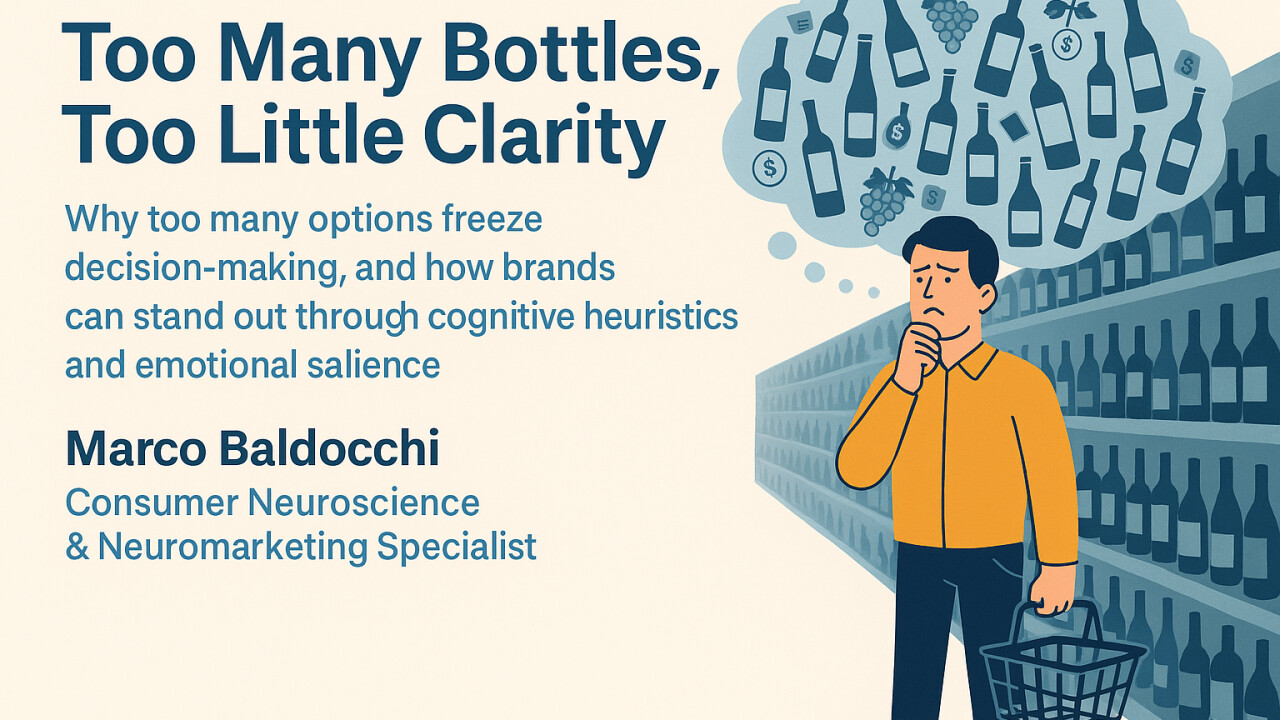
Why too many options freeze decision-making, and how brands can stand out through cognitive heuristics and emotional salience
By Marco Baldocchi – Consumer Neuroscience & Neuromarketing Specialist
Too Many Bottles, Too Little Clarity
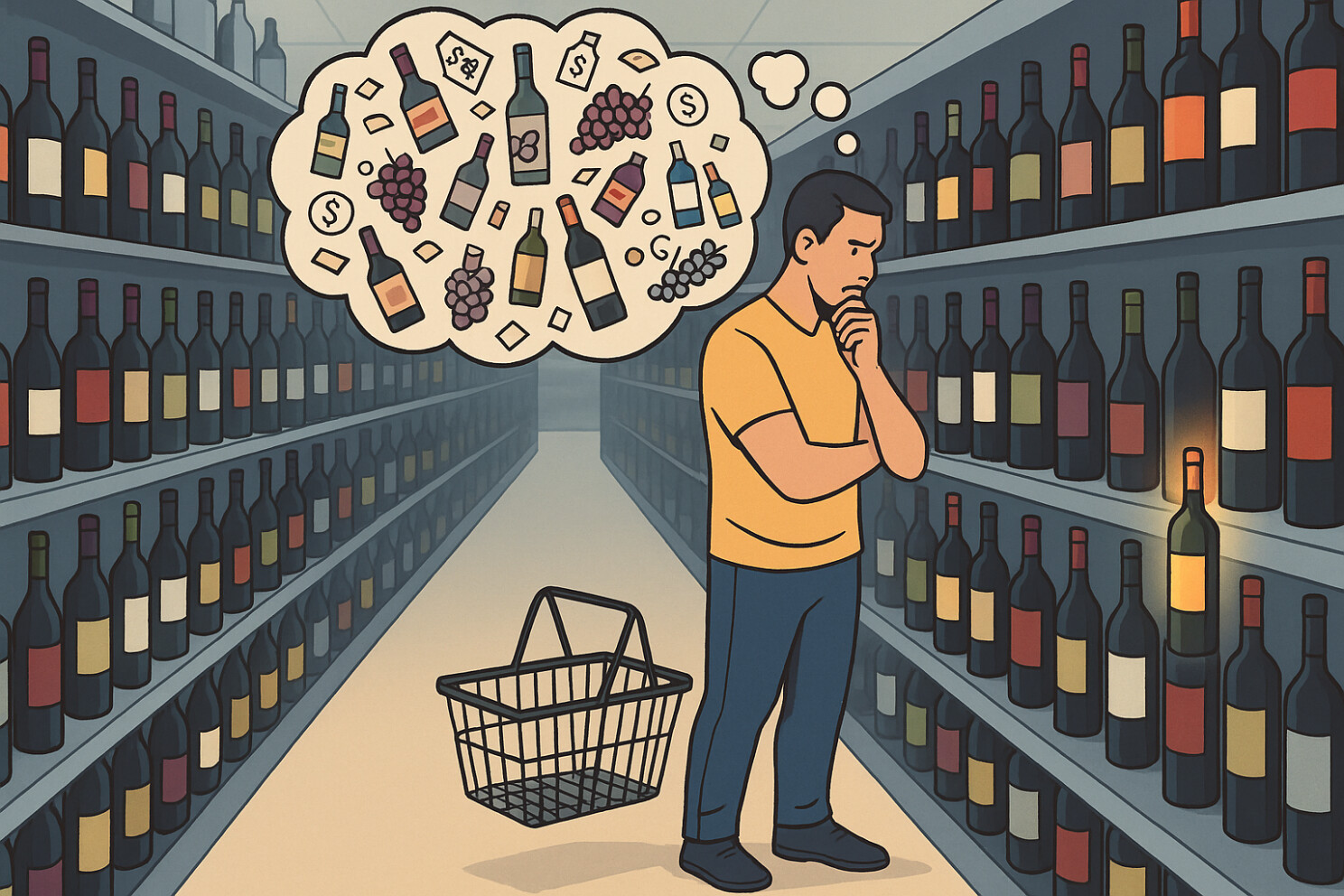
Walk into a wine shop or scroll through an online catalog and the problem is immediate: hundreds of labels, dozens of regions, a flood of grape names and price tiers. Instead of excitement, many consumers feel something else: paralysis.
Behavioral science has a name for this: choice overload. Sheena Iyengar’s famous “jam study” showed that more options often reduce – not increase – purchases. Neuroscience explains why: the prefrontal cortex, which handles rational evaluation, has a limited working memory. When options exceed that capacity, the brain shuts down. In wine retail, this means abandoned baskets, confused shoppers, and missed opportunities.
And the evidence goes deeper: a 2018 study by Reutskaja and colleagues found that when participants faced large choice sets, neural activity in key valuation circuits (dorsal striatum and anterior cingulate cortex) decreased. More options didn’t add value – they actually suppressed the brain’s reward system.
How the Brain Simplifies Decisions
When overwhelmed, the brain doesn’t analyze. It shortcuts. These shortcuts are called cognitive heuristics – fast, unconscious rules of thumb that reduce complexity. In the wine aisle, that might mean:
-
Visual cues: gravitating toward a label with strong contrast or elegant typography.
-
Price anchors: assuming mid-priced bottles are “safe” choices.
-
Familiarity bias: choosing a region, grape, or brand name we’ve seen before.
-
Emotional salience: picking the wine that “feels right” because the design or story triggered positive affect.
Recent EEG research by Hu et al. (2024) shows how this works at the neural level: large option sets reduce early attentional signals (P1, P2, N2 waves) and increase late positive components (LPC), reflecting greater emotional strain and cognitive load. In plain terms: too many bottles weaken attention, then overload the brain with decision stress. Heuristics step in as survival mechanisms.
The Emotional Brain in Action
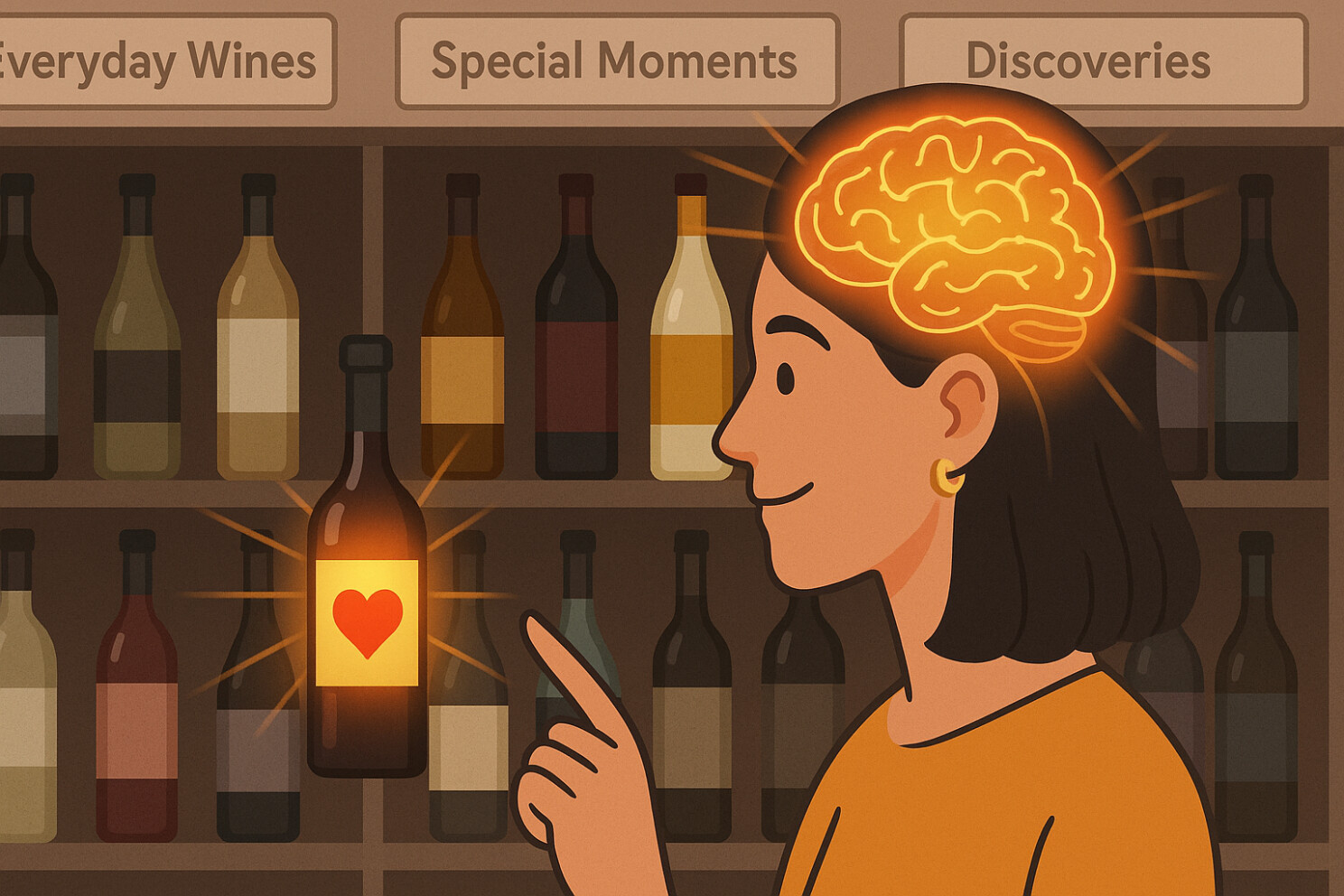
If heuristics reduce complexity, emotions create clarity. fMRI studies demonstrate that when a product triggers emotional salience – through design, narrative, or context – the brain lights up in valuation circuits (ventromedial prefrontal cortex). That makes the decision feel easy, not heavy.
This has direct implications for wine. A study by Plassmann et al. (2008) showed that when identical wines were labelled at different prices, brain activity in the medial orbitofrontal cortex increased with higher perceived value – even though the wines were the same. The emotional context of price shaped the actual neural experience of pleasure.
Similarly, Peng et al. (2021) found that information overload leads to elevated LPC signals associated with regret. Even after making a decision, the brain continues to process “what could have been.” In wine retail, that means a shopper who finally chooses a bottle may walk away less satisfied if the choice came after overwhelming complexity.
Today, however, we have tools that allow us to measure these dynamics with precision. Through facial coding, for example, we can read consumers’ unconscious emotions before and during the choice, tracking micro-expressions that reveal enthusiasm, surprise, indecision, or frustration. Platforms like Emotivae make this approach accessible: they can analyze up to 98 different emotions, along with levels of attention and cognitive load. This way, brands can understand in real time which stimuli create connection and which instead generate blockage.
From Overload to Engagement: Practical Implications
For wineries and retailers, the goal isn’t to add more SKUs. It’s to reduce friction and amplify salience:
-
Design for recognition: bold, distinctive visual codes cut through clutter better than technical descriptions.
-
Guide with anchors: curated selections, “staff picks,” or clear price ladders help consumers navigate without fatigue.
-
Tell micro-stories: a phrase, a place, an emotion on the label can prime the purchase more than a tasting note.
-
Shape the context: lighting, music, and even shelf placement influence which bottle “feels right” at the moment of choice.
Research on choice structuring (Mogilner et al., 2020; see also PMC11111947) shows that grouping options into meaningful sets reduces complexity without limiting variety. Instead of 60 bottles displayed all together, segmenting them into “Everyday Wines,” “Special Moments,” and “Discoveries” helps the brain process with less strain.
And here comes a crucial point: it’s not enough to copy others’ style or align with dominant visual trends. The real challenge is to develop a clear and recognizable own style that becomes a salient signal for the consumer’s brain. In neuroscience, salience means exactly this: what stands out from the noise, captures attention, and sticks in memory. A label that dares, a coherent visual language, a unique story – these are the elements that transform choice from cognitive fatigue to instant recognition.
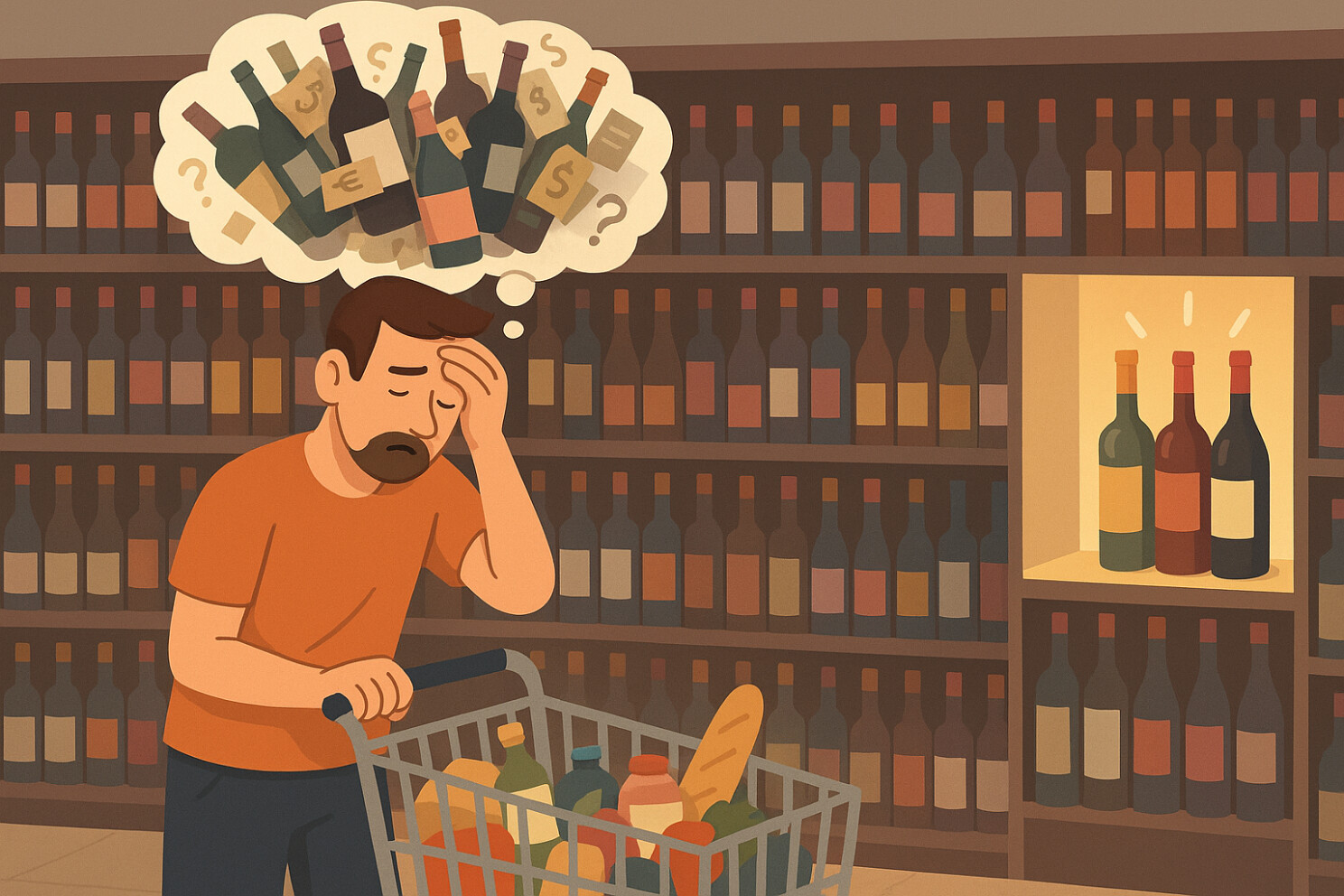
The Weight of Decision Fatigue
The more decisions consumers make, the worse their subsequent decisions become – a phenomenon known as decision fatigue. Neuroscience explains this as the depletion of self-regulatory resources. Repeated acts of choosing activate prefrontal regions until cognitive efficiency drops. In practical terms: if wine is the fifth or sixth choice in a shopping journey, a cluttered shelf can be the tipping point toward abandonment.
This is why simplifying presentation and creating emotionally salient cues is not just “good branding.” It’s a cognitive service to the consumer.
Toward Smarter Wine Retail
Wine is a category rich in heritage and diversity – but that richness backfires if it overwhelms the brain’s decision systems. Neuroscience suggests a simple principle: less analysis, more emotion. The brands that stand out are those that transform choice from a cognitive burden into an intuitive, rewarding experience.
Because when the brain freezes, the hand doesn’t reach for the shelf. But when the brain feels, the decision flows.
Meet the Author:

Marco Baldocchi is the founder and CEO of Neuralisys Inc., based in Miami. He serves as Director of Neuromarketing Research at the National Association for Applied Neuroscience and is a founding member and Head of Research at ONCEMS (National Observatory of Communication and Marketing for Sustainability).
Marco is the author of several books and scientific publications, and a speaker at national and international events. He lectures at 24Ore Business School, Università Cattolica of Milan, and Florida International University (FIU). He is a member of the Neuromarketing Science & Business Association (NMSBA) and was ranked among the Top 10 Best World Speakers in the Neuromarketing Series 2021.
He is also a member of the Miami Scientific Italian Community (MSIC). In 2023, he was included in the prestigious Insight250 list, which honors the top 250 global experts in marketing and consumer behavior. That same year, he was selected for inclusion in the international edition of Marquis Who’s Who, ranking in the top 3% globally in the fields of consumer behavior, neuromarketing, and neurobranding.
He was a TEDx speaker in 2023 in both Miami (US) and Lucca (Italy). His company was named “Most Scientific Marketing Agency 2023 – Southeast USA” at the Media Innovator Awards. In 2025, Marco invented and patented Emotivae Sense, an AI and neuroscience-based software that detects emotions in real time through facial micro-expression analysis. Once emotions are recognized, Emotivae Sense can adjust environmental factors - such as lighting, sound, color, and scent - to help regulate and rebalance negative emotional states.
References for further reading:
-
Reutskaja, E., et al. (2018). Choice overload reduces neural signatures of choice set value. Nature Human Behaviour.
-
Hu, X., et al. (2024). Electrophysiological mechanisms of choice overload: evidence from ERP. Frontiers in Neuroscience.
-
Peng, G., et al. (2021). Information overload and decision regret: ERP evidence. Frontiers in Neuroscience.
-
Plassmann, H., et al. (2008). Marketing actions can modulate neural representations of experienced pleasantness. PNAS.
-
Vohs, K., et al. (2014). Decision fatigue: The psychology of depletion. Annual Review of Psychology.
-
Mogilner, C., et al. (2020). On the advantages and disadvantages of choice. Perspectives on Psychological Science.
Be part of the launch of Rethinking Wine. Join our community: Click Here