Priscilla Hennekam
Released 23 Dec, 2025
I realised the real problem after a conversation with a winery owner from McLaren Vale, in a clothing store here in Australia. She was the missing piece of my puzzle. Suddenly, everything made sense.
We started talking about wine and I said something like, “It’s not only in wine, is it?”
She said, “I know. It’s all manufacturing businesses.”
That sentence stayed with me. My head wouldn’t stop spinning, because she was right, and the reason is much deeper when you look at what’s happening to other manufacturing industries too.
We’re moving from a manufacturing society, through an information society, and now into an AI society. And when that shift happens, everything changes for anyone whose competitive advantage used to be built on making and selling physical products.
This is one of the quotes that keeps echoing in my mind, from one of my favourite philosophers:
“Art does not die because there is no more art. It dies because there is too much.” - Jean Baudrillard
Abundance changed the rules. When everyone can access anything, products lose power. Attention becomes noisy. Information becomes cheap. In a world of abundance, meaning becomes the differentiator. People don’t buy what’s best. They buy what feels aligned, safe, and human.
So I went deeper. Reading, reflecting, talking, listening - with some of the sharpest minds in our industry. Hopefully, what I’m about to share will challenge your thinking. I really want this newsletter to make you stop and #rethink.
So please - don’t just read and move on.
Leave your thoughts in the comments. I want to take this further with people who can see beyond the obvious, and who aren’t afraid of uncomfortable questions.
Because questions keep you in movement. When you stop questioning, you slip into stagnation, into survival mode, instead of creation.
Thank you, with lots of gratitude.
To everyone who’s been waiting on the mailing list for over a year - thank you.
We’ve had issues along the way while building the Rethinking Wine platform. It’s been messy. It’s been slow. It’s been heavier than people can see from the outside.
But I kept coming back to this:
“Obstacles can’t stop you. Problems can’t stop you. Most of all, other people can’t stop you. Only you can stop you.” - Jeffrey Gitomer
We haven’t stopped.
We’re still here. Still building. Still pushing. And now it feels like it’s getting close - like it’s finally becoming real.
If you haven’t left your email yet, and you want to be part of the launch of our Rethinking community, join us here: https://www.rethinkingwine.app/
The Wine Industry Is Treating Symptoms
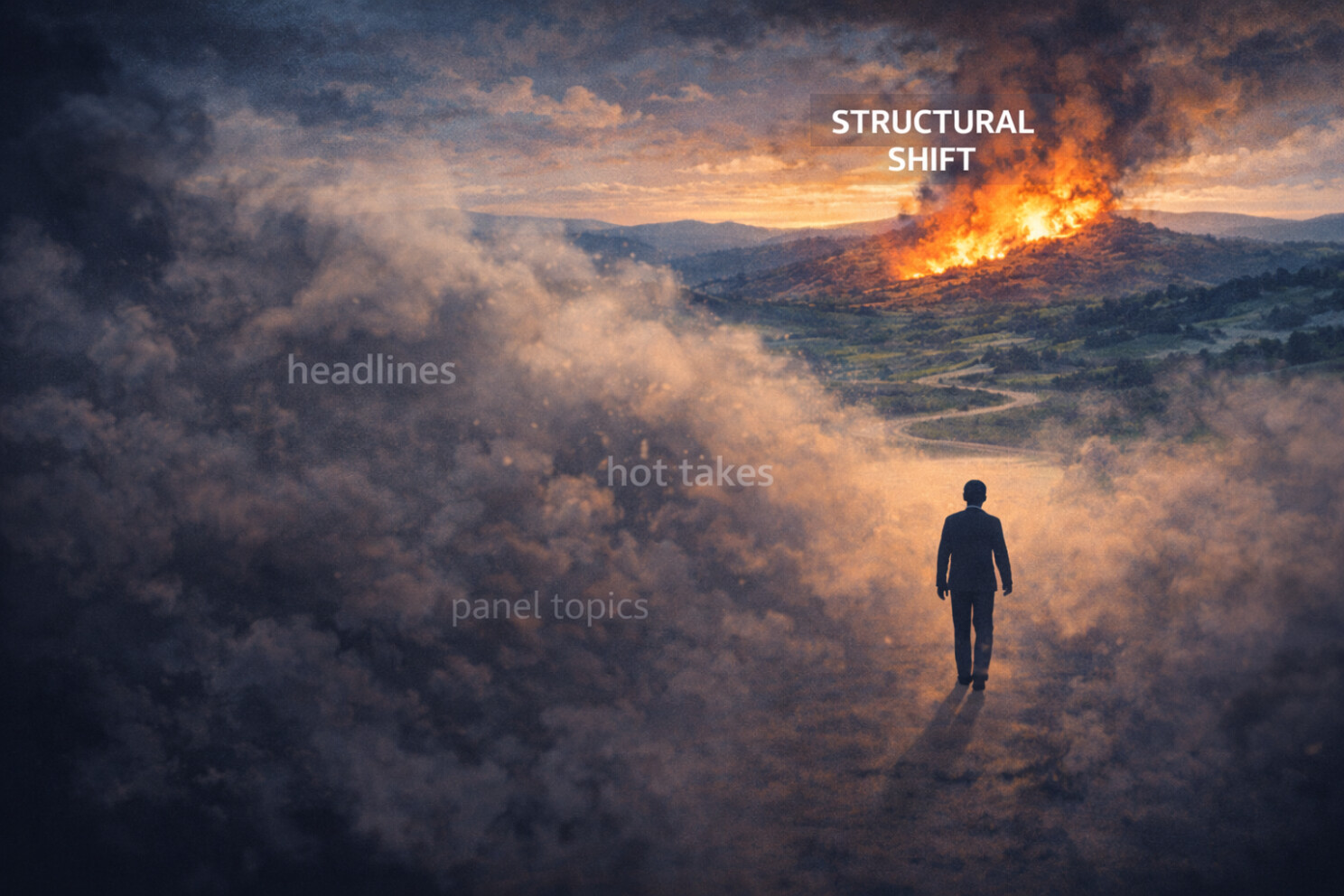
Every week there’s another headline, another hot take, another “this is the reason wine is struggling”:
-
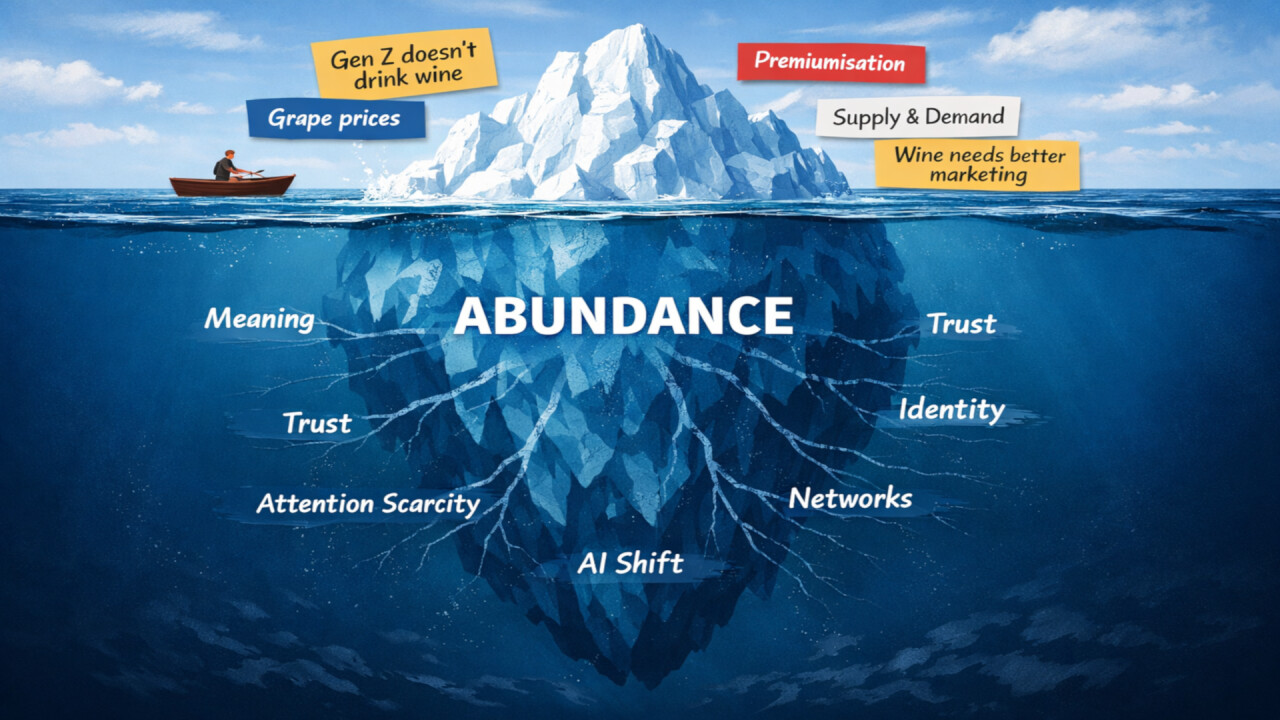
Gen Z doesn’t drink wine.
-
Supply and demand is broken.
-
Grape prices are too low.
-
Premiumisation is a trap.
-
Wine needs better marketing.
And yes - these things matter. I’m not dismissing them.
But they’re mostly symptoms.
The symptoms are loud. They’re easy to measure. Easy to debate. Easy to turn into a panel topic.
Roots are quieter. Slower. Harder to explain in a headline.
So we end up doing what humans always do under pressure: we chase what’s visible. We treat the symptom because it feels actionable, and we ignore the structural shift because it’s uncomfortable.
That’s why the “news” can become a trap. News tells us what’s happening now, which usually means it’s already the past. It’s the smoke, not the fire. It makes us reactive. And reactive businesses don’t build the future, they defend the present.
So instead of adding more noise, I want to do the opposite in this newsletter. I want to zoom out. To look at how we got here, to study the bigger waves moving through society: scarcity to abundance, product to choice, authority to networks, information to AI. Because when you can see the pattern, you stop guessing. You start anticipating.
And once you can anticipate, you stop reacting in panic, and you start building with clarity.
Scarcity → Abundance
Phase 1 - Scarcity was real
Early societies were genuinely scarce.
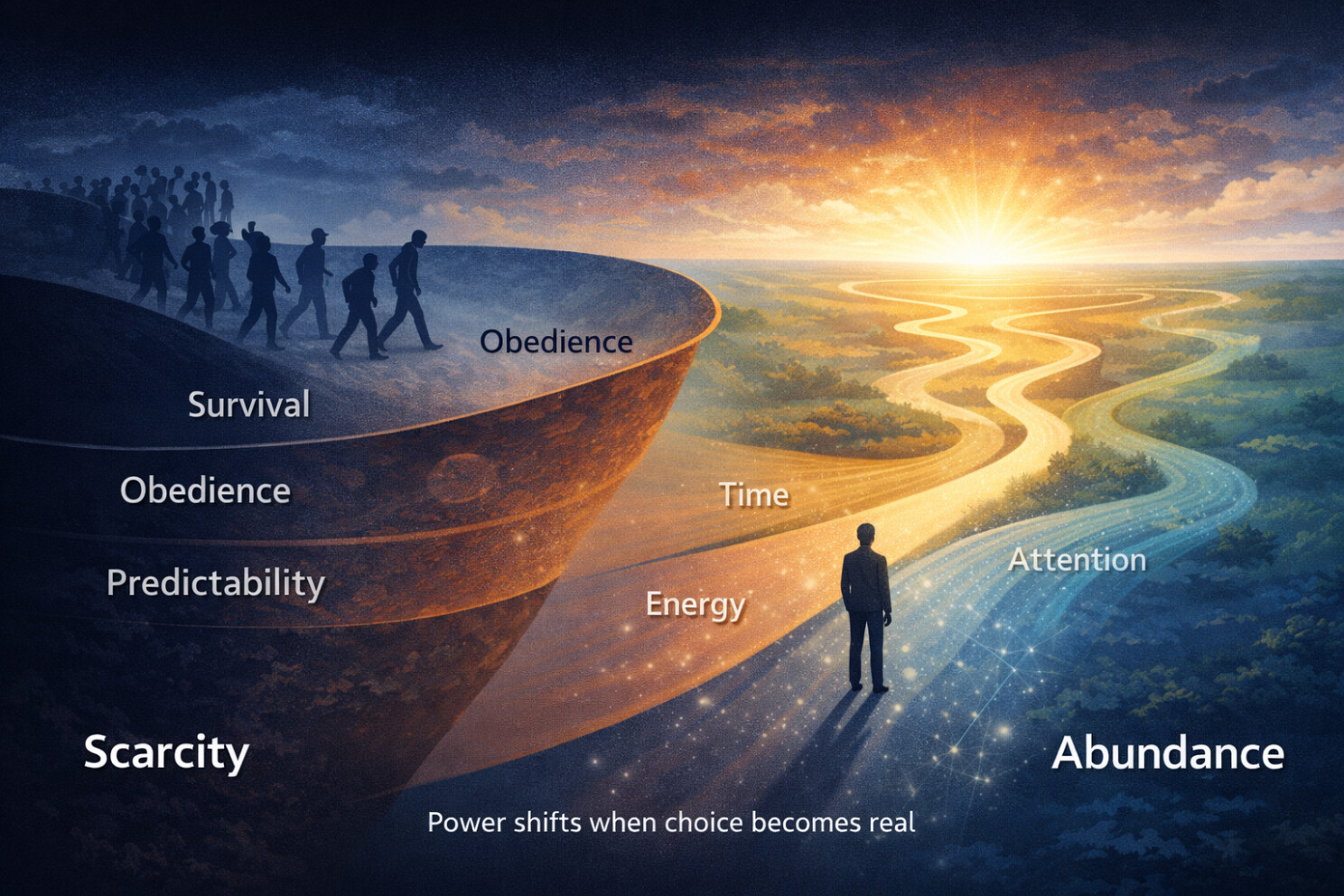
Food, safety, shelter were uncertain. Hierarchies formed for coordination and protection. Power concentrated because coordination required it.
But there was a trade-off: People gave up autonomy for survival. This wasn’t evil. It was adaptive.
Phase 2 - Scarcity became a strategy
As societies stabilised, scarcity stopped being only real. It became managed.
Kings, churches, states, later corporations. Control of land, knowledge, money, access. Scarcity narratives reinforced obedience: “There isn’t enough.” “You need us.” “This is the order.”
Trade-off: People gave up voice, agency, and meaning in exchange for predictability. Power learned that fear of loss is easier to manage than trust.
Phase 3 - Industrial capitalism: efficiency over humanity
The industrial era optimised for output.
Humans became “labour”. Time became a unit. Value became productivity. Work divorced from meaning. This is where something got hard-coded: what is measurable matters more than what is meaningful.
Trade-off: People gained comfort, goods, stability - but lost connection to craft, community, and self.
Phase 4 - Consumer capitalism: identity for sale
As productivity peaked, growth needed a new engine.
So capitalism shifted from meeting needs to creating desire. Status replaced survival. Identity replaced community. Consumption replaced belonging.
Trade-off: People outsourced identity to jobs, titles, and brands, and meaning to markets.
Phase 5 - Information abundance: the mask slips
Now something breaks.
Information is abundant. Goods are abundant. Options are abundant. Authority is decentralised. Scarcity - the old control mechanism - stops working.
And suddenly people see: We’re exhausted. We’re anxious. We’re lonely. We’re working endlessly to maintain lifestyles we didn’t consciously choose.
Abundance changes behaviour because it changes the power relationship. When the world was scarce, people tolerated things they didn’t love because they had to.
When the world becomes abundant, people start asking a different question:
Is this worth it?
Not worth the money. Worth the time. Worth the attention. Worth the energy. Worth the emotional cost. This is why so many people feel exhausted and strangely empty, even in “successful” lives. It’s why they’re pulling back.
-
From overwork.
-
From constant buying.
-
From anything that feels extractive.
And yes - from alcohol. They’re reassessing what deserves space in their life.
Product → Choice
This is where the wine industry keeps misreading the room. We keep talking as if the game is still supply and demand: plant less, make less, raise prices, wait for balance to return.
But abundance changed the battlefield. The real problem isn’t only volume. It’s replaceability.
In an abundant world, consumers can swap brands in seconds. They have endless alternatives. Their attention is scarce. Their trust is fragile. Controlling supply doesn’t rebuild desire. It doesn’t rebuild meaning. It doesn’t rebuild connection.
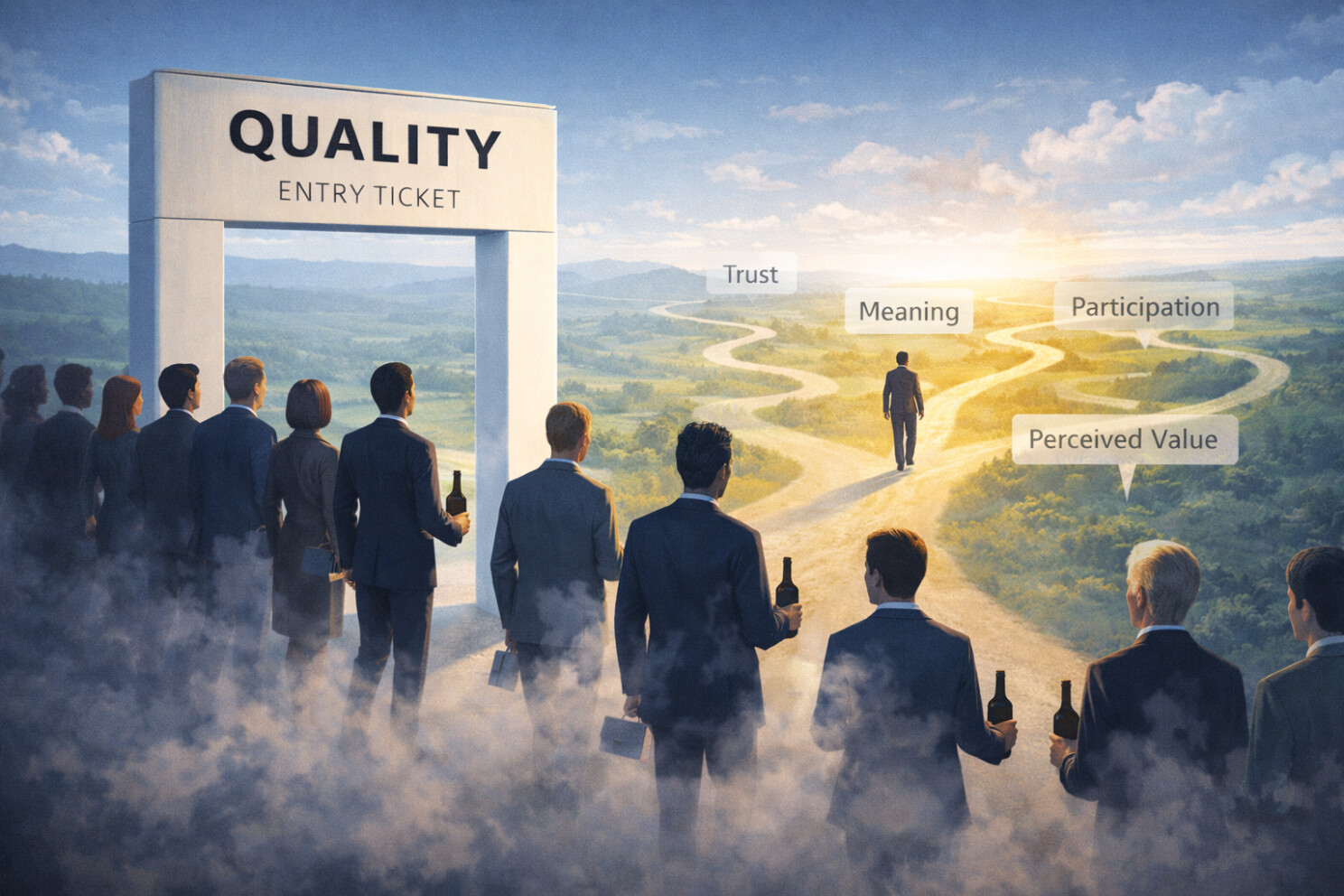
And this is the key line many wine businesses still haven’t absorbed: In 2025, quality is not the advantage. Quality is the entry ticket.
So when wine businesses struggle, it’s rarely because their product isn’t good. It’s because they’re still trying to win using Product Era levers in a Choice Era market. In abundance, you don’t win by being “better” inside the old rules, because everything becomes crowded, copyable, and noisy.
So competition moves:
-
From product superiority to perceived value.
-
From distribution power to trust power.
-
From brand control to customer participation.
-
From status to meaning.
Authority → Networks
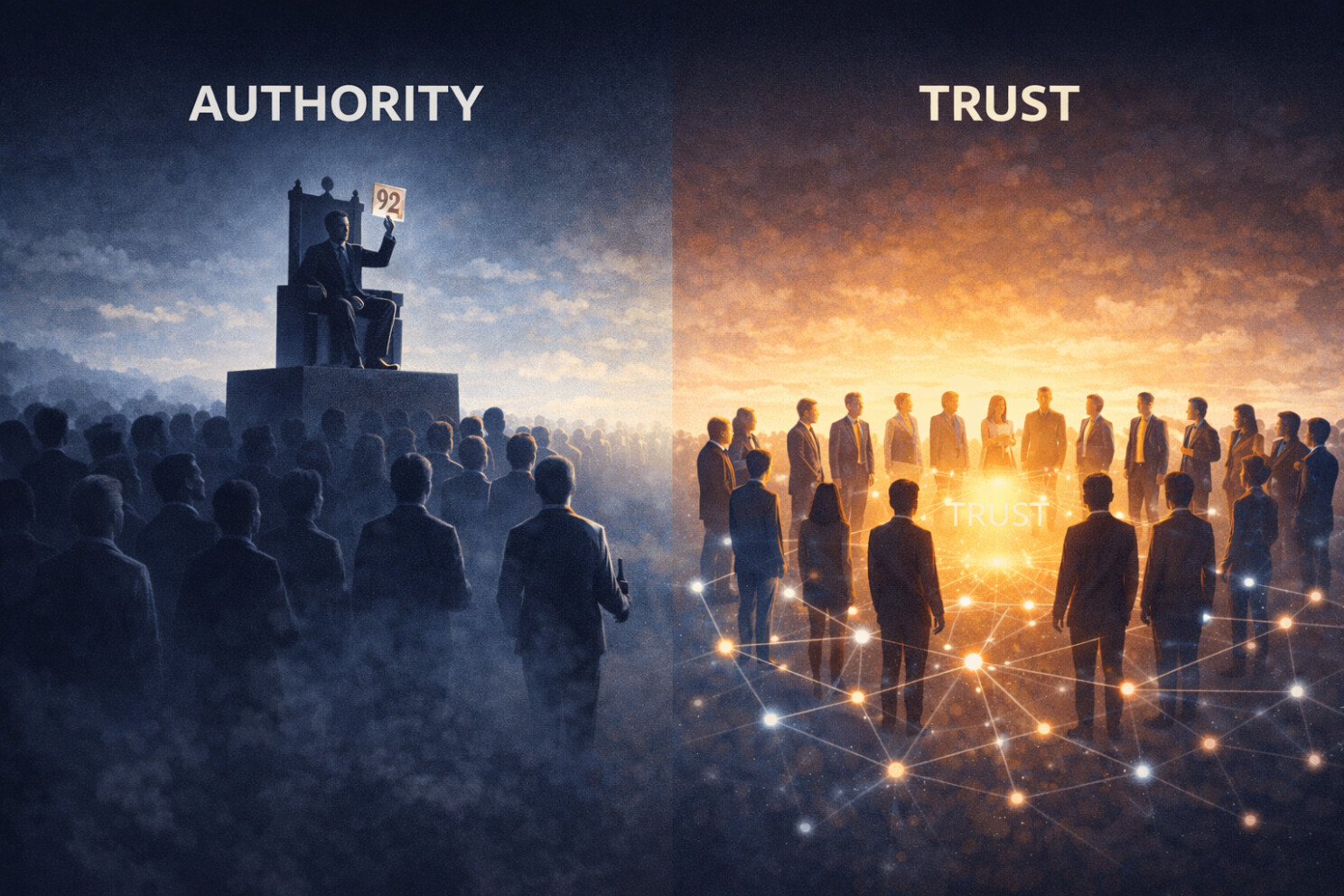
Wine, as we know it today, was built in a world where authority was central. Critics. Scores. Medals. Prestige. Gatekeepers. Institutions. That model worked when information was scarce and customers needed someone to tell them what mattered.
But decentralised information changed something fundamental. It didn’t just give people more knowledge. It removed the ability to hide intention.
Ego became visible.
Marketing became comparable. Claims became searchable. Reputation started travelling faster than advertising. So power moved again. Away from institutions and toward networks. And networks don’t behave like institutions.
Networks reward:
-
Belonging over status.
-
Peer trust over expert dominance.
-
Participation over performance.
-
Warmth over intimidation.
This is where gatekeeping starts to backfire, because distance doesn’t create desire anymore.
Our society is moving into a world that’s vastly different than the one most wine brands were built for. We are living in a world of abundance - abundant options, product variations, and information. And in an abundant world, people don’t stay loyal out of habit. Each purchase is a vote, and people will vote for what feels relevant, welcoming, and aligned.
And if wine feels confusing, intimidating, or distant, it’s not surprising that they don’t force themselves into it. They just choose something else.
Information → AI
Now here’s the part that makes all of this more urgent: Even the abundance or information era is already becoming a problem from the past, because the next wave is AI.
AI is not just a tool. A tool waits for you to use it. AI doesn’t. It acts. It learns. It predicts. It optimises. It scales. It creates. It persuades. It does not feel.
And this is your sharpest frame:
-
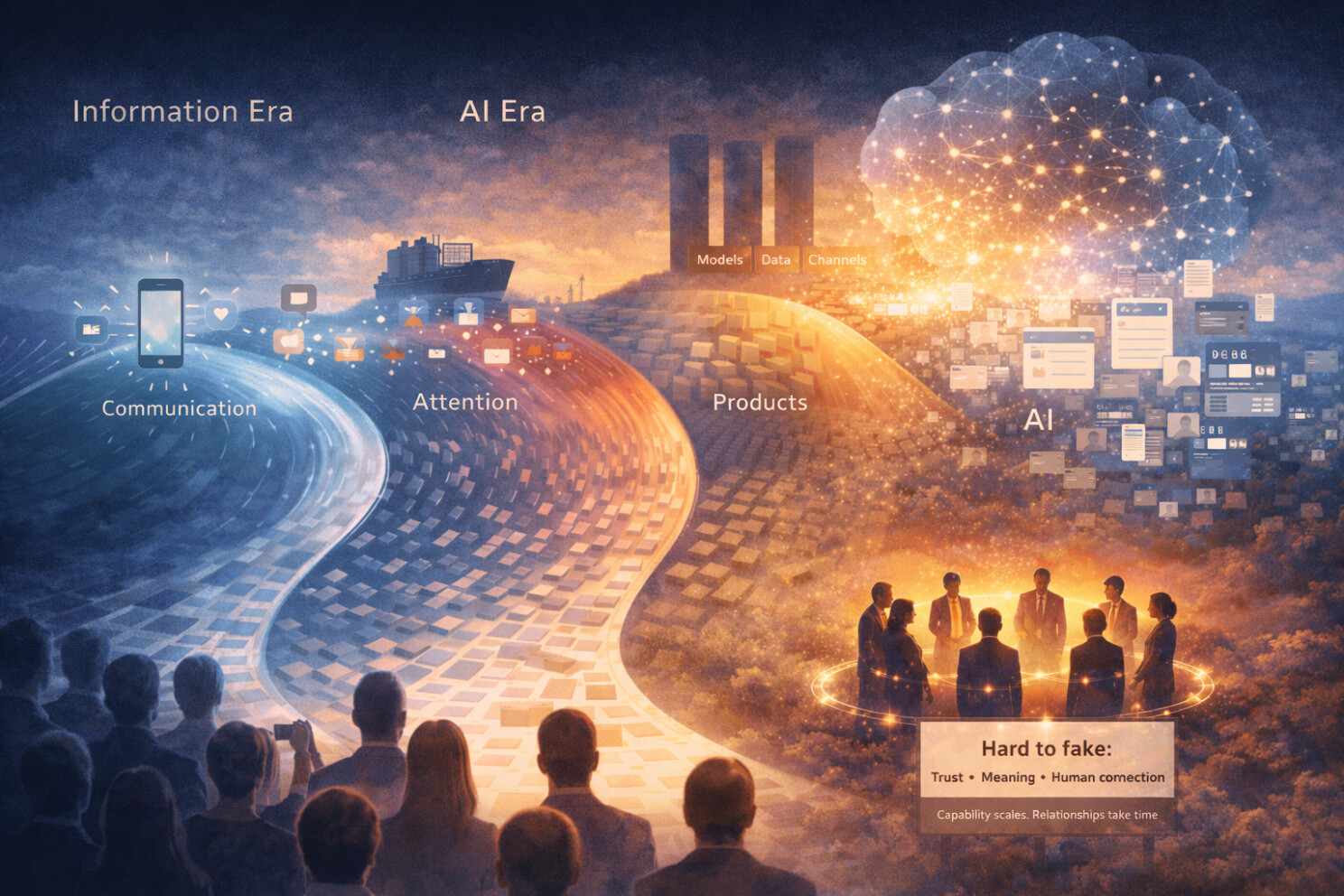
The iPhone decentralised communication.
-
Social platforms decentralised attention.
-
Global suppliers commoditised products.
-
AI commoditises capability.
Suddenly, individuals can do what used to require a whole team. One person can design, write, edit, analyse, build campaigns, generate visuals, test messaging, run support - all faster than ever and at a fraction of the cost. Capability becomes cheap. Output becomes infinite.
But at the same time, power concentrates again, not in vineyards or distribution networks, but in the systems that own the models, the data, and the channels where attention flows.
So scarcity returns, but in a completely different form.
Not scarcity of product. Not scarcity of “quality”. Not even scarcity of information.
The new scarcities are:
-
Scarcity of attention (because everything is competing for it)
-
Scarcity of trust (because anyone can look credible)
-
Scarcity of meaning (because content can be generated, but purpose can’t be automated)
-
Scarcity of human connection (because relationships take time, and AI can’t replace that time)
And this is where I think the wine industry is at risk of missing the real moment. We’re still obsessed with old scarcity signals - prestige, scores, status, auction headlines - even while the evidence is right in front of us: prices soften, narratives wobble, and the “status game” becomes less reliable as a growth strategy. It’s not that prestige doesn’t matter to anyone. It’s that prestige won’t be the scarce asset.
In the AI era, the scarce asset will be what can’t be mass-produced:
Trusted relationships, built over time, inside communities where people feel seen.
If wine keeps acting like the old world - chasing hierarchy, defending complexity, speaking in codes that make outsiders feel small, we’ll lose relevance in a market where people have endless alternatives and very little patience for friction.
Because when everything becomes easy to copy, the advantage shifts from “who looks premium” to: who feels human. And in a world flooded with content and “perfect” branding, the most valuable asset becomes what can’t be faked.
In abundance, the customer doesn’t need you. They choose you.
If This Challenges You, Good
That’s my intention.
Because the wine industry can’t keep reacting forever. Defence is not a strategy, it’s a delay. And delays feel safe… right up until the moment they become expensive. If we want a better future for wine, we need forward thinkers who are willing to zoom out, question old scripts, and create new paths before the headlines tell us what we already lost.
So please - don’t just read this and move on.
Leave your thoughts in the comments. Tell me what you think the real root is. Tell me what you’re seeing in your market. Tell me what you think I’m missing. I want this to be a conversation, not a broadcast.
Because the future of wine won’t be built in isolation. The world is moving too fast, and in too many unpredictable ways. No single person, brand, or region can “figure it out” alone anymore. It will be built through collaboration, through shared intelligence, healthy debate, and people brave enough to rethink together.
And if you want to be part of the launch of our Rethinking community, join us here: https://www.rethinkingwine.app/