
Priscilla Hennekam
Released 2 Sept, 2025
How many times have I seen marketing campaigns where a £18 wine is promoted as beating a £130 wine in a blind tasting?

For decades, the focus of business has been competition. Beating your competitors. This is even more apparent in wine, where “scores” really allow you to take aim at your competitors in the public eye.
Yet what does that say about the industry? And what good does it do to “beat” your competition, to get a larger piece of the pie, if the size of the pie is shrinking every day?
The marketplace is changing. The world, and the climate, are changing. We face more challenges today than ever, and these challenges cannot be solved by a single winery, region or even a single country alone. Solving our current problems demands collaboration. But instead, our instinct is to turn inward and compete harder.
I’ve been told so many times that what I’m promoting can’t be done, that collaboration in wine is impossible. “Competition is the right mindset”, they say. “It’s competition that drives us to grow, it’s what pushes us to be better, to feel rewarded, to succeed”.
But I can’t help but wonder:
Have we been conditioned, by the system, to believe that our success only comes when others fail? That in order to rise, we must push others down?
It’s time to stop and ask ourselves what would serve us best, both individually, and as an industry?
Wine is already losing ground to other drinks that focus on consumers and current trends, while we spend our energy debating whether innovation (ironically some of the few shining lights for the industry) should even be allowed - and publicly undermining our competitors.
What does that tell consumers? If half the industry “can’t be trusted”, why should they trust any of us? Why would they put in the effort to learn who they can trust, when there are so many other options available to them?
Let’s be honest - our wine will never be the only bottle our consumers drink. Even winemakers love exploring other people’s wines. Why fight that reality? Instead of telling consumers not to trust our competitors, why not celebrate them?
If what you create is truly yours – something born from your story and your vision, then no one can really copy it. And even if they try, by the time they catch up you’ll already be innovating again. In that sense, competition stops being a threat.
What matters is building an “abundance mindset”. When we move away from “scarcity” and “rivalry”, consumers can feel it. Wine shifts from being a guarded, hostile space into something warm, inviting, and generous, a culture people actually want to be part of.
In a world where everything is interconnected, can we really afford to stay isolated, focused only on ourselves? How can we expect to shape the future of our industry if we keep thinking alone, locked in silos? How can true innovation happen if we shut ourselves off from the very idea of working together?
Do we honestly believe growth can happen without others by our side?
If we want real change, it starts with us
I believe that in this new era, where the future of business and success is rooted in networks, trust, and mutual benefit, it’s time for us to rethink the very foundations of the wine industry.
At Rethinking the Wine Industry we’re developing a space for winemakers, business owners, managers, marketers, sommeliers, technologists, and prosumers share ideas openly, new solutions emerge that no single voice could create alone.
We believe that collaboration is the foundation of innovation. For us, collaboration means:
Shared Knowledge, Collective Action, Breaking Silos and Mutual Growth.
The wine industry doesn’t need more competition; it needs a collaborative mindset to unlock the future. And that’s what our platform is here to enable.
Our community already spans over 80 countries. To join us, add your name to the waiting list today and help us reshape the future of wine - www.rethinkingwine.app
Let’s challenge the status quo. Let’s move beyond the “scarcity mentality” that has kept us isolated and driven only by competition. Let’s build something that lasts. Together.
The Role of Networks: Moving from Competition to Collaboration
The idea that competition drives us to keep innovating is most applicable to monopolies. In a monopoly, lack of competition leads to complacency and stagnation. But the wine industry is not a monopoly. It’s one of the most competitive marketplaces in the world, with multiple sources estimating over 100,000 wineries – not to mention the number of labels available. Trying to be “the best” is not just unviable for 99% of businesses, it’s a path to frustration, stress and all the associated negative health conditions.
The wine industry’s fragmented approach to competition isn’t just outdated, it’s counterproductive.
The challenges for wine businesses go far beyond this. No single company could possibly deliver the complex, ever-changing solutions society demands year after year, not to mention make meaningful headway on issues as far-reaching as climate change. So why not join forces and leverage the strengths of others?
In a world where information flows freely and ecosystems thrive on cooperation, the old models of rivalry simply won’t work.
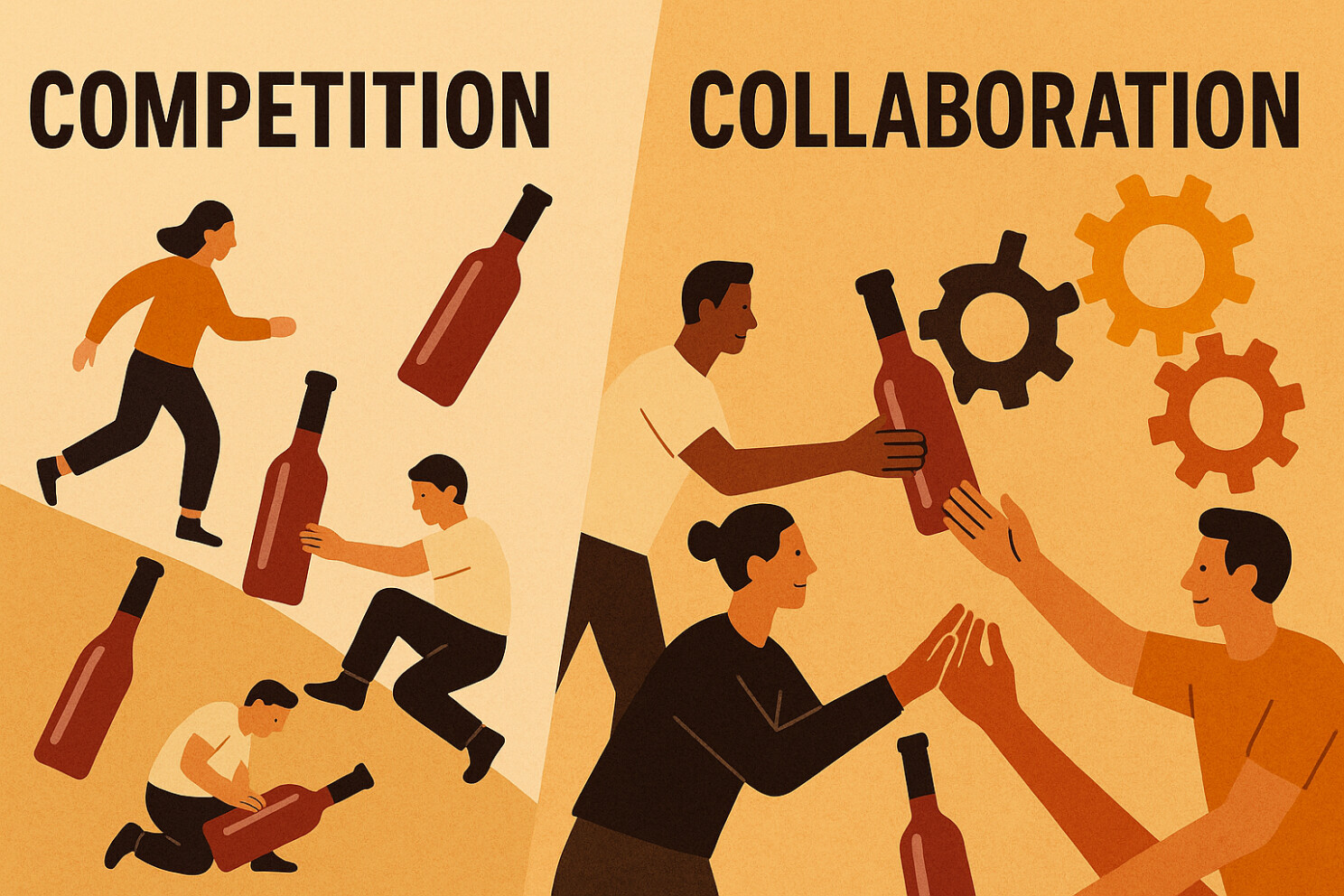
This brings us to a critical point: collaboration over competition. In a networked economy, competition no longer drives innovation, it’s the collective power of collaboration that creates breakthroughs. In ‘The End of Competition: The Impact of the Network Economy’, Cor Molenaar says that in the network economy, businesses should focus on building ecosystems instead of simply outcompeting each other.
When we collaborate, we build value that benefits everyone. The idea of “winning” becomes irrelevant; instead, we focus on co-creating solutions and empowering each other to thrive. We create a win-win ecosystem, where everyone from the smallest boutique winery, to the largest distributor, benefits from mutual support. By working together, the wine industry can build a more resilient, innovative, and sustainable future.
Purpose-Driven Success: Why Being the Best Is No Longer Enough
The days when business success was defined by “being the best” are behind us. Now, more than ever, businesses must align their strategies with purpose. We can no longer afford to see success as a zero-sum game where one’s gain is another’s loss. Purpose-driven businesses are those that solve real problems and create value for their community, whether that’s within the wine industry or any other field.
For example, in the world of sustainability, companies are shifting away from competing for attention and market share. Instead, they are collaborating to advance shared goals. Take the efforts in sustainability education: empowering global communities to earn sustainability credentials together, for instance, is a far more impactful strategy than any competitive advantage gained from being “the best” in isolation.
The Scarcity Mentality and the Power of Open Source Thinking
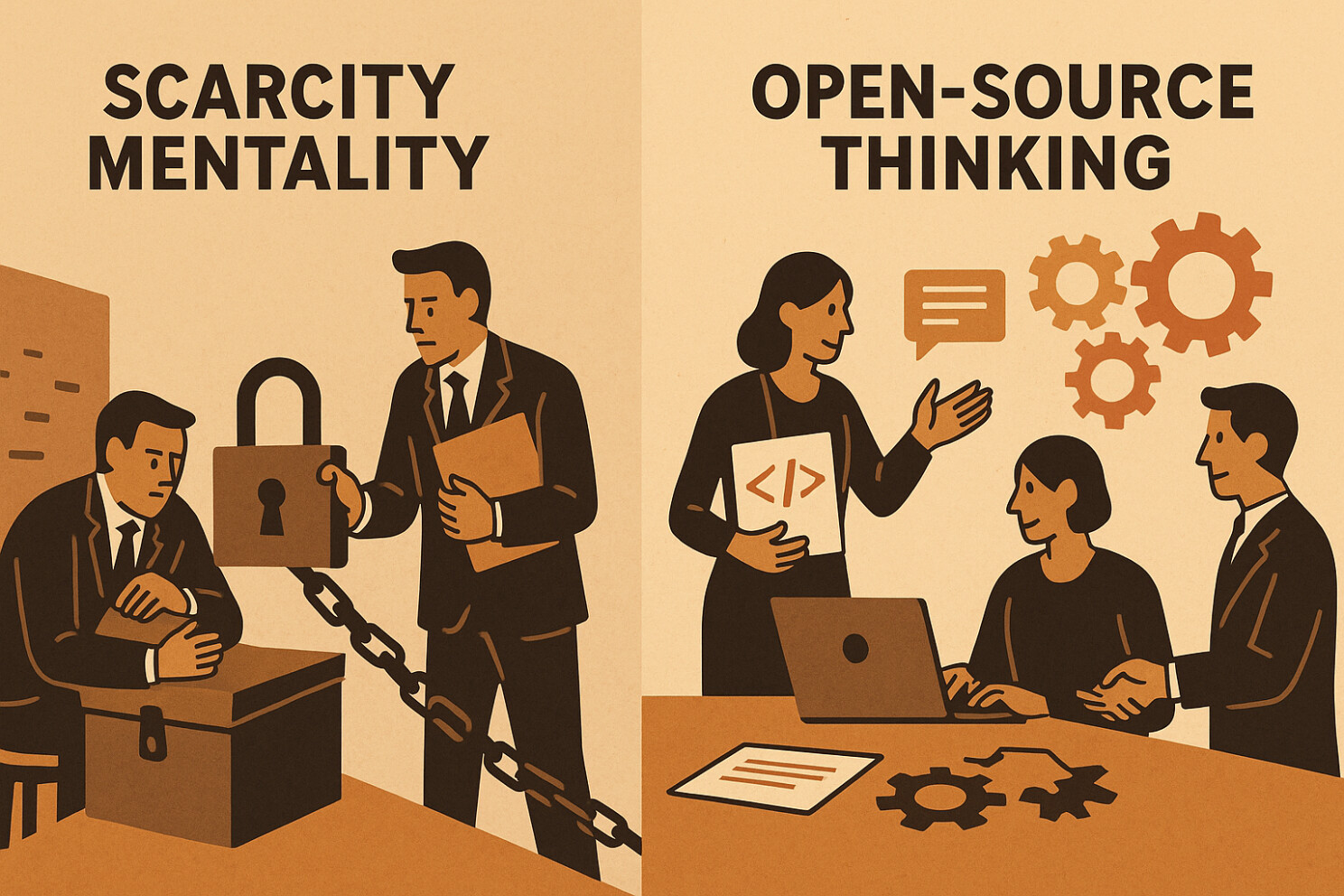
In business, the “scarcity mentality” has long kept companies focused on hoarding their intellectual property and competing fiercely. However, the rise of open-source thinking is shifting this paradigm. Much like the digital commons and open-source software, businesses can now benefit from shared resources, collaborative knowledge, and transparent, open development processes.
Tesla’s decision to open-source its patents in 2014 is a perfect example. Instead of guarding its innovations, Tesla chose to share them in order to drive the broader industry forward, challenging the status quo and accelerating the adoption of electric vehicles globally. This wasn’t about competing; it was about creating a collective solution to a global problem. And in doing so, Tesla positioned itself as a leader, not through isolation, but through collaboration.
Mercedes and BMW - historic rivals - joined forces to create FreeNow, a mobility “superapp” across 16 countries. They realised their customers didn’t just want cars, they wanted movement. Collaboration gave them access to new technology, new markets, and new forms of value. The pie grew bigger for both.
This is the lesson for wine. Our future lies not in guarding knowledge, but in building ecosystems of collaboration - winemakers, distributors, retailers, educators, even competitors - who come together around shared problems. When we connect diverse skills, ideas, and resources, we don’t just survive disruption, we thrive through it.
We’ve seen how collaboration in other industries drives both innovation and resilience. Why should wine be different?
The myth is that competition alone drives excellence. The reality is that collaboration makes us more competitive at the next level. That’s how ecosystems in business - and in nature - work.
So the question for us is simple: what problem are we really trying to solve? And who must we work with to solve it?
The future of competition is collaboration. And in wine, that future is overdue.
Moving from Stress to Clarity: The Business of the Future
There’s another vital lesson here. In today’s competitive world, many entrepreneurs spend excessive time worrying about their competition. Are they stealing customers? Are they innovating faster? This constant stress can take a toll on business owners, and even their health. But what if we shifted our focus from competing to collaborating?
By adopting this new mindset, entrepreneurs can release the stress of competing for market share and instead focus on creating and nurturing relationships, both within their industries and with their customers. The businesses that thrive in the future won’t be those that stress over competitors; they’ll be the ones who innovate through collaboration, and who lead with purpose, trust, and influence.
The Future of Wine: Shifting Focus from Competition to Co-Creation
Instead of clinging to the old competitive model, businesses that focus on community, collaboration, and shared knowledge will be leading the way. It’s about creating a dynamic ecosystem where innovation isn’t confined to a few players at the top but is fostered throughout the entire industry. By leveraging networks of professionals, consumers, and collaborators, we can reshape the wine industry into something more inclusive, forward-thinking, and sustainable.
A Call to Action for Rethinking Wine
In the past, employees were loyal to their companies, exchanging job security for hard work. The traditional model in 'The Organization Man’ (1956) painted a picture of employees in gray suits, working for the corporation, and following a clear career path. But that world has changed.
Today, businesses are more flexible. People are free agents, entrepreneurs, and intrapreneurs. They navigate their careers like landscapes, not fixed paths. We don’t stay loyal to institutions; we build connections across networks. We need each other more than ever. The future is not about competing harder, but about connecting deeper. The real opportunity lies in collaboration, finding shared purpose and working together to solve problems, rather than focusing on who’s ahead or behind. We need to embrace new ways of communicating, marketing, and collaborating that move beyond traditional, siloed practices.
As we continue to rethink the wine industry, let’s ask ourselves:
-
How can we build ecosystems of collaboration, where all players, from wineries to consumers, have a stake in the future?
-
How can we use the power of networks to amplify our impact and drive innovation?
Together, we can turn collaboration into our most powerful tool for success.